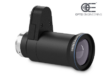



Remote motorized lenses—equipped with electronically controlled focus, zoom, and iris—represent a valuable enhancement in vision systems where consistency, uptime, and repeatability are critical. Instead of manually adjusting optics on-site or accessing hard-to-reach cameras, users can fine-tune imaging parameters remotely, store configurations, and quickly restore predefined settings.
What is a remote motorized lens?
A remote motorized lens incorporates built-in motors and control electronics that allow adjustment of focus (image sharpness), zoom (field of view or magnification), and iris (aperture, influencing brightness and depth of field) via a controller or software interface.
This makes such lenses particularly advantageous for cameras installed in enclosures, behind safety guarding, on moving machinery, or in controlled environments where physical access is limited and adjustments are time-consuming or costly.

Faster setup and changeovers
One of the primary benefits is the reduction in setup time. In environments with frequent product changes or multiple SKUs on the same line, manual lens adjustment can become a bottleneck. Remote control allows faster optimization of framing and focus, helping minimize downtime and restore stable inspection performance more quickly.
Repeatability with recipe-based imaging
Manual adjustments often vary between operators and situations. With motorized control, it becomes straightforward to save ideal configurations and reliably return to them. This consistency can improve first-pass yield, reduce false rejects caused by suboptimal images, and decrease reliance on specialized personnel for system tuning.
Remote serviceability and fewer maintenance visits
For cameras installed in elevated, enclosed, or otherwise difficult-to-access locations—such as cleanrooms or guarded areas—many imaging issues can be resolved remotely. This reduces the need for on-site maintenance, shortens repair times, and improves overall equipment effectiveness, especially across multiple production lines or facilities.
Compensation for environmental drift
Real-world factors such as vibration, temperature variation, mechanical settling, or changing lighting conditions can gradually affect image quality. Motorized lenses allow operators to compensate for these changes in real time by adjusting focus, iris, or zoom, preventing performance degradation without interrupting production.
Adapting to variable working distances
In systems where the distance between the camera and target changes—due to robotics, moving stages, pallet variations, or product differences—remote adjustment of focus and zoom ensures consistent image framing and clarity. This supports accurate measurement and inspection without requiring manual intervention.
Safety and compliance improvements
If lens adjustments typically involve opening safety guards, stopping equipment, or accessing elevated or controlled areas, remote control reduces the need for such actions. This can lower the frequency of lockout/tagout procedures and minimize operator exposure during troubleshooting and optimization.
Industries with strong ROI potential
Several industries benefit significantly from remote motorized lenses:
- Manufacturing and industrial automation: multi-SKU inspection, gauging, label verification, and assembly validation
- Electronics and semiconductor inspection: high sensitivity to focus precision and repeatability for small features
- Logistics and distribution: overhead or hard-to-access scanning and measurement stations
- Food and beverage: washdown environments where setups shift and access is restricted
- Pharmaceuticals and medical devices: consistent verification processes supporting quality systems
- Automotive and tier suppliers: high-uptime production with many product variants
- Energy and utilities: remote locations where travel time and site access are challenging
Estimating return on investment (ROI)
ROI can be evaluated by examining the current cost of manual lens adjustment. Key factors include:
- Downtime per changeover multiplied by frequency and cost per minute
- Number of maintenance visits avoided (including labor and travel)
- Yield-related impacts such as scrap, rework, and false rejects
- Time savings during system deployment and reconfiguration
In high-throughput operations, even small efficiency gains can quickly justify the adoption of motorized lenses.
Conclusion
Remote motorized lenses are not just about convenience—they provide greater operational control. By enabling repeatable imaging, faster changeovers, and fewer disruptions caused by limited access, they help improve OEE and reduce total cost of ownership. For operations focused on uptime and consistent inspection quality, they offer a highly effective optimization tool.
Computar’s LensConnect series
For a practical example, the Computar LensConnect series is designed with these same advantages in mind. It offers remote control of focus, zoom, and iris, supports repeatable configurations, and reduces the need for on-site adjustments—making it ideal for systems where uptime, limited accessibility, and multi-recipe operation are key ROI drivers.

Key features and models
- Compatible with large-format sensors (IMX183)
- Floating focus design for ultra-high resolution
- The only machine vision lens with optical zoom functionality
- Fixed focal length models: 8mm, 12mm, 16mm, 25mm, 35mm, 50mm, 75mm
- Varifocal models: 4–10mm, 9–50mm, 12–36mm, 16–96mm, 25–50mm
- NEW: LensConnect Telecentric focus-driven lens series (0.25X, 0.5X, 1X, 2X magnification)
The LensConnect series is engineered to enable both power supply and control via USB. This Plug-and-Play solution allows remote adjustment of zoom*, focus, and iris, and includes user-friendly setup software compatible with Windows and Linux (*zoom adjustment available for varifocal models only).
Remote operation is simple to implement, even without prior lens expertise. The floating focus design ensures ultra-high resolution across varying distances, while stepper motors provide precise control and excellent repeatability.