

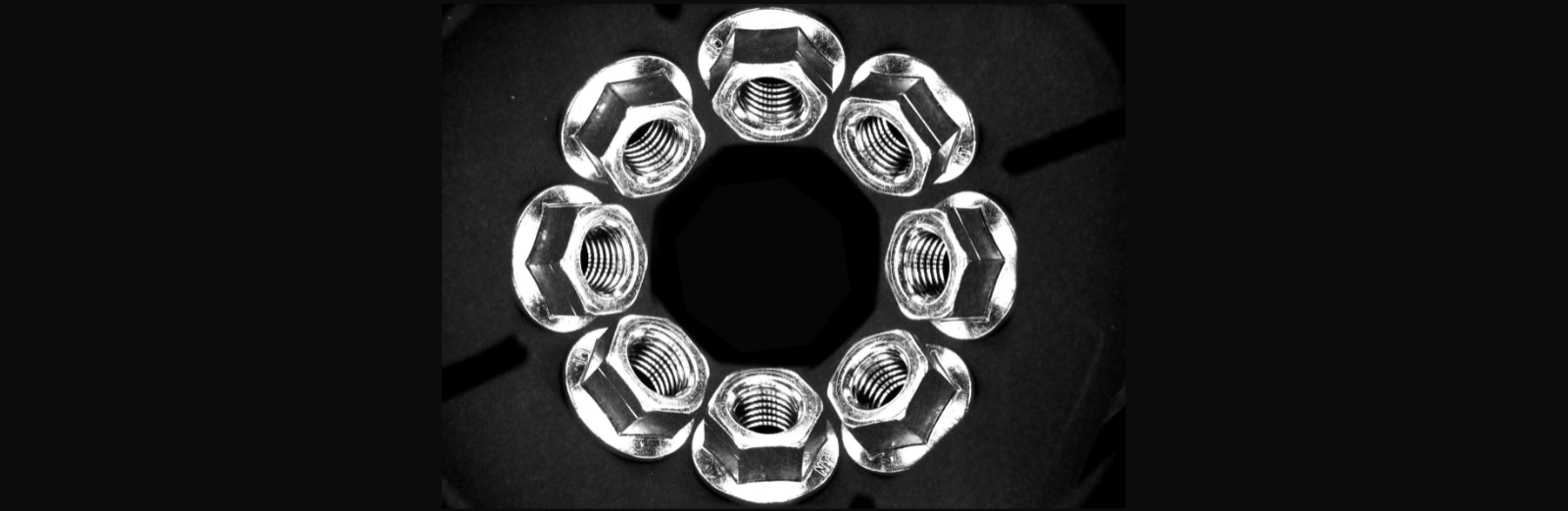
Improving defect inspection efficiency with Opto Engineering 360-degree multi-view optics
In today’s machine vision applications, speed, accuracy and reliability are no longer optional—especially in industries such as food & beverage and pharmaceutical manufacturing, where even the smallest defect can lead to costly recalls or compliance issues.
360-degree and multi-view optical solutions address these challenges by enabling complete, all-around inspection in a single image acquisition, significantly simplifying system design while increasing throughput and robustness.


The challenge of multi-surface inspection
Many vision tasks—including OCR, barcode verification, defect detection and integrity checks—require inspection from multiple perspectives. Typical challenges include:
- randomly positioned or oriented parts,
- features located on both external and internal surfaces,
- limited installation space on high-speed production lines.
Traditional vision setups often struggle to meet all these requirements efficiently.
Limitations of conventional multi-camera and line scan systems
Multi-camera systems are a common approach for capturing different views of a product. While they offer flexibility and high resolution, they also introduce several drawbacks:
- large system footprint due to minimum working distance constraints,
- increased hardware and software complexity (multiple interfaces, GPUs),
- longer setup, calibration and synchronization times,
- higher risk of failure due to the number of components involved.
Line scan solutions can deliver excellent image quality for cylindrical objects, but typically require mechanical rotation of either the camera or the part—making them less suitable for high-speed applications and often requiring additional cameras for top and bottom inspection.
360-degree optics: complete inspection in a single shot
360-degree lenses offer a smarter alternative. Using just one camera and one exposure, they capture a comprehensive view of a 3D object’s surface as a 2D image that can be digitally unwrapped for analysis.
Depending on the optical design, these lenses allow inspection of:
- the top and outer surface of an object, or
- the entire inner surface of cavities.
This single-shot approach dramatically reduces system complexity and improves inspection speed.

Simpler systems, faster image processing
From a system integration perspective, 360-degree optics provide clear advantages:
- no mechanical rotation required,
- fewer components,
- faster and more straightforward image processing,
- improved reliability and uptime.
While precise centering is important and resolution may be lower than some multi-camera configurations, the overall efficiency gains often outweigh these trade-offs in real-world production environments.

Key categories of 360-degree optical solutions
To meet diverse inspection requirements, several types of 360-degree and multi-view lenses are available:
Outer surface inspection


Pericentric lenses use a converging optical design to simultaneously image the top and side surfaces of an object, making them ideal for applications such as:
- vial and bottle inspection,
- cap verification,
- OCR and code reading for track-and-trace,
- PET preform inspection.


Pericentric catadioptric lenses integrate mirrors into the optical path, enabling compact designs, wide viewing angles, high resolution and compatibility with non-visible wavelengths—well suited for demanding pharmaceutical and food packaging applications.
Inner surface inspection
Inner inspection lenses feature a cylindrical field of view that allows simultaneous inspection of cavity sidewalls and bottom surfaces from outside the part. They are commonly used to detect defects in:
- caps and closures,
- paper cups,
- complex mechanical components.


Boroscopic probes provide panoramic, high-resolution images from inside cavities by inserting the optics directly into the part. These solutions are ideal for detecting contaminants, scratches, dents and thread defects in both industrial and food & beverage applications.
Multi-view and poly-view inspection


Mirror-based multi-view lenses capture multiple equally spaced views—often four, six or even eight—from a single camera shot. This makes them highly effective for:
- pharmaceutical vial inspection,
- cannula dimensional measurement,
- electronic connector and pin inspection.
By eliminating the need for multiple cameras, these solutions improve consistency and reduce system complexity.


The latest innovations in 360-degree imaging
Recent developments include large field-of-view catadioptric lenses capable of inspecting objects up to 110 mm in diameter—ideal for food cans and large caps.
Hypercentric lenses enable simultaneous inspection of inner walls and cavity bottoms through narrow openings, making them particularly valuable for high-speed beverage and container inspection.
In addition, the integration of liquid lens technology allows electronically controlled focusing within milliseconds. This enables:
- rapid refocusing without mechanical movement,
- greater flexibility for variable sample sizes,
- reliable operation in robotic and high-throughput environments.
Conclusion
360-degree and multi-view optical technologies are transforming machine vision inspection by delivering faster, simpler and more reliable defect detection. With single-shot acquisition, reduced system complexity and growing optical innovation, these solutions provide a strong competitive advantage for manufacturers operating in quality-critical industries.